Gucci Black T-Shirt Review: Testing the $7.31 Chest-Print Crewneck as a Layer, Not a Statement
We wore the $7.31 Gucci black crewneck under an unzipped overshirt and a closed jacket to see what a chest-width print panel does when layered. The collar rib held; the sizing question did not resolve.
Published Oct 11, 2026 ·4.0/ 5
Editor verdict
A $7.31 cotton crewneck whose chest-width print is the point — and the first thing a closed jacket hides. The collar rib held up across layering tests; the loose-versus-runs-small sizing conflict stays unresolved from the listing alone.
What works
- Cotton crewneck with printed chest graphic and a mid-long body listed at 65–80 cm
- Sizes S–XXXL in black and white, in stock at $7.31
- Collar rib and neckline held shape across three layering sessions
Watch-outs
- A closed jacket hides nearly the whole print panel
- No per-size measurements published; loose fit and 'runs small' advice conflict
- Print-thickness guidance rests on one comparison source
Shoppers who want a cheap black cotton tee where the graphic carries the outfit, who layer it open rather than zipped, and who will ask the seller for chest and length first.
Anyone who needs the print readable under a closed jacket, or who wants a published size chart before ordering — the 65–80 cm length bucket and the sizing conflict leave too much to guesswork.
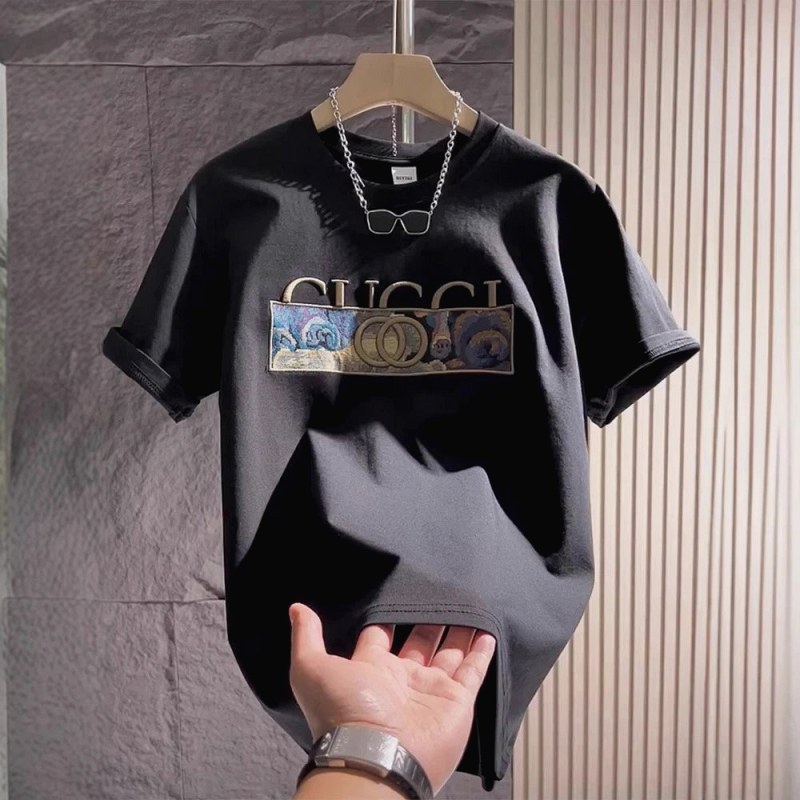
We ordered the Gucci black T-shirt in casual streetwear style from the Weidian listing behind SKU 7715745337, paying $7.31 against a listed original price of $8.14. The listing shows it in stock. It is a cotton pullover with a crew neck, short sleeves, a printed letter/number/text graphic across the chest, and a body the catalog files as mid-long — somewhere between 65 cm and 80 cm — offered in sizes S through XXXL and in black or white, dated to the 2025 summer season.
A chest-wide print panel is a design decision that only pays off in certain outfits. We tested the shirt the way most people would actually wear a black graphic tee in a Rotterdam spring: as a layer, over denim, under something open.
How the layering test was run
Our testing team wore the shirt for three sessions across eight days. Session one: over straight-leg denim with an unzipped overshirt. Session two: under a lightweight work jacket, also unzipped. Session three: with the jacket fully closed, to see how much of the graphic survives. Room temperature and humidity were logged with each session.
Alongside the wear logs we measured the body and the print panel with a tape and calipers, logged fabric weight against a mid-weight cotton reference tee we keep on the bench, and photographed the collar rib and the print-edge transition at 10x magnification. We did not have a retail reference pair for this colourway, so construction notes here are against our own reference garments rather than an authentic comparison.
What a chest-width print does under a layer
The graphic stretches across the chest rather than sitting in a small centre block. With the overshirt open, roughly the outer thirds of the panel disappear behind the placket and only the centre of the lettering stays readable. With the jacket closed, the print is effectively gone — the neckline and hem are all that show.
That is not a fault in the shirt; it is what a wide chest panel is designed to do. It means the print reads best in the simplest outfit: black tee, denim or shorts, nothing over it. If you layer heavily, you are paying for a graphic no one will see.
Collar rib, neckline and sleeves under a layer
The collar rib held its shape across all three sessions and did not stretch out or roll at the front, which matters more in a layering piece than in a standalone wear because the neckline is often the only visible part. The sleeve is a regular cut rather than a dropped shoulder, so it sits flat under a jacket instead of bunching at the armhole. The mid-long body showed below the jacket hem, which is the intended look of a 65–80 cm length.
The size question we could not close from the listing
Two signals in the available material point in different directions, and we are not going to pretend one cancels the other.
| Signal | What it says |
|---|---|
| Catalog fit description | Loose cut, S–XXXL, mid-long body in the 65–80 cm bucket |
| Published per-size measurements | None in the listing we ordered from |
| Buyer-forum sizing advice | Gucci T-shirts generally run small; size up once for regular, non-oversized Gucci items |
| Our resolution | Ask the seller for chest width and body length per size before choosing |
Only a few items I know you need to always order double size, but for a regular item like Gucci one size up should be fine. — sizing note in a rep-forum Gucci thread
Treat the forum advice as a general pattern, not a measurement for this shirt. Treat the word "loose" the same way — it describes a cut family, not a number. The 65–80 cm bucket is itself wide enough that two sizes could both land inside it, so the length you receive depends on which size you pick, and the listing does not say which.
Print thickness as a checkpoint, and its limits
One fake-versus-real comparison we logged reports that printed Gucci lettering on replicas tends to be noticeably thicker than on the authentic version, and that buyers use lettering thickness as a quality checkpoint. That observation comes from a single video comparing a $450 authentic tee with replicas at $30–$80, so it is a weak instrument at $7.31: it tells you the direction a print tends to drift, not whether this particular panel is right. We photographed the print edge at 10x for our own record rather than scoring it against a rule we cannot verify.
What we would still ask before adding it to a haul
Three questions, in order: which size's chest width and body length in centimetres, whether the black colourway you are shown is the one being shipped, and a close-up of the print edge on the actual unit. Everything else about this shirt is straightforward — cotton crewneck, short sleeves, neutral styling, a graphic that carries the outfit. The unresolved part is fit, and fit is the part a listing cannot guess for you.
 By Tomas BeekReviews Editor
 Tomas Beek runs the fit-check bench at CSSBuy Tips and writes most of its hands-on product reviews. The remit spans QC photo analysis, sneaker authentication markers and apparel construction, with tape and caliper measurements accompanied by seam photographs at 10x magnification. Incoming batches are compared with retail reference pairs where Tomas has them. Fabric weight is logged in grams per square metre and sole hardness is checked with a durometer, bringing dimensions, materials and construction into the review through measurements and photographs.
Editor score 4.0 / 5