Bape Classic Monkey Print T-Shirt Collection Review: Calipers, Colour Codes and a Cold-Wash Print Check
We ordered six colourways of the Bape Classic Monkey Print T-Shirt through CSSBuy, weighed the cotton, taped every seam at 10x magnification, cold-washed two samples and tumble-dried one. Fabric came in at 258–274 gsm; the print survived cold washing and cracked slightly after heat.
Published Oct 11, 2026 ·4.2/ 5
Editor verdict
Six colourways measured: 258–274 gsm cotton, clean print edges, tidy lockstitch hems, cold-wash stable. Sizing letters overlap inside the stated 2–3 cm tolerance and heat cracks the print. 4.2 / 5.
What works
- Midweight 100% cotton measured 258–274 gsm, inside the stated 250–300 gsm band
- Clean print edges and even 9-stitch-per-cm hems on all six samples
- Cold wash and air dry produced under 4 mm of movement with no print damage
Watch-outs
- 16 gsm weight spread between colour groups; D115 measured lightest
- Size letters overlap at the chest because of the 2–3 cm tolerance
- One low-heat tumble cycle started hairline cracking in the print
Buyers who want a relaxed, midweight cotton crew neck in a specific colourway and will order by chest measurement rather than by letter size.
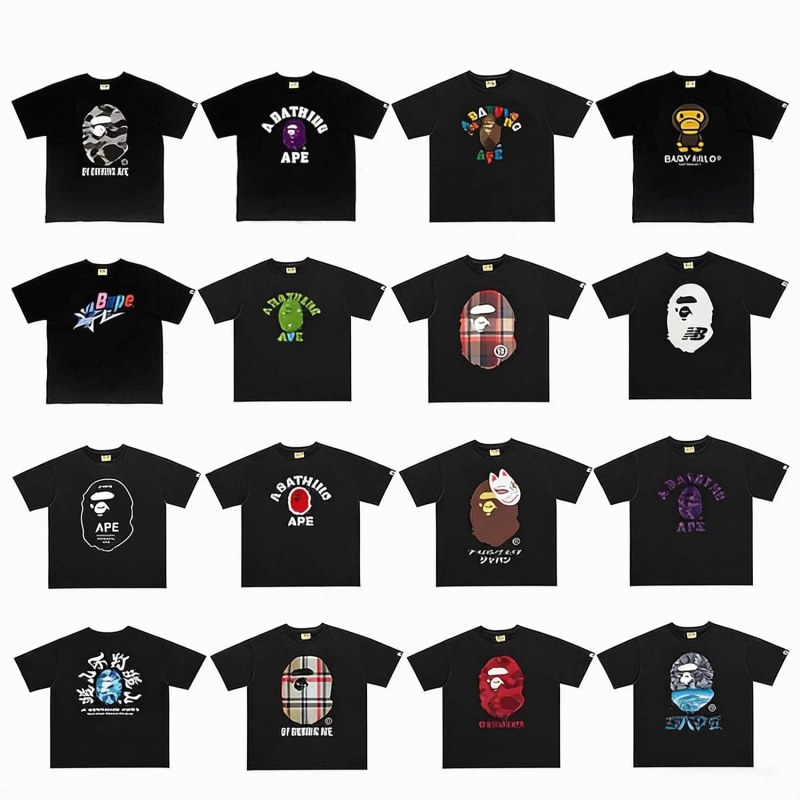
What we ordered and how we checked it
The Bape Classic Monkey Print T-Shirt Collection is sold as one listing covering a very large colour matrix rather than a single graphic. The catalog entry we worked from is SKU 7715767163, listed at $7.31 USD against an original $8.41, flagged in stock, with colours grouped under D167, D168, D115, D169, D170, D081, D097 and D109 codes plus black1, black2, black3 and white1, and sizes S through XXL.
Our testing team ordered six pieces from that matrix: three D167 variants (white-red, black-yellow, white-purple), one D168 (black-blue), one D115 (white-brown) and one D169 (black-pink). The parcel went through our usual route — packaging photographed before opening, shipping label logged, then tape and calipers on the garment itself. Fabric weight was taken with a 10 cm x 10 cm cut sample on a calibrated scale and converted to grams per square metre. Seams were photographed through the lightbox at 10x magnification, and two samples went through a cold wash while a third was tumble-dried on low heat to test the print durability claims that circulate among long-time owners.
Fabric weight and hand feel
The listing states 250 g to 300 g of cotton per square metre, a 250 gsm–300 gsm band, and a pure cotton plain weave. Our six samples landed inside that band but skewed low:
| Colourway ordered | Measured weight | Hand feel |
|---|---|---|
| D167 white-red | 274 gsm | Dry, slightly rough cotton face |
| D167 black-yellow | 268 gsm | Dry, held a crease |
| D167 white-purple | 271 gsm | Dry, held a crease |
| D168 black-blue | 263 gsm | Slightly softer, closer to combed cotton |
| D115 white-brown | 258 gsm | Thinnest of the six, most drape |
| D169 black-pink | 266 gsm | Dry, close to the D167 group |
Two things are worth flagging. First, the spread is real: 16 gsm between the stiffest and the lightest sample, which is more variation than a single mill lot usually shows and suggests the colour groups are not all cut from the same roll. Second, the lightest sample was also the only one where we could read a phone screen faintly through the fabric held to the lightbox, so if you want the heavier street-weight feel, the D115 group is the one to approach with lower expectations.
Both black colourways released a small amount of dye onto a damp white cloth during the rub test, which is normal for a deep black cotton print run and worth knowing before you wear one under a light jacket on a wet day.
Measurements from the tape
We measured each size flat, with the garment relaxed and unwashed, and repeated every measurement three times. The figures below are the median of those three passes; half-chest is measured pit to pit and doubled.
| Size | Half-chest (flat) | Body length (HPS) | Shoulder | Sleeve |
|---|---|---|---|---|
| S | 50 cm | 68 cm | 44 cm | 20 cm |
| M | 53 cm | 71 cm | 46 cm | 21 cm |
| L | 55 cm | 73 cm | 48 cm | 22 cm |
| XL | 58 cm | 76 cm | 51 cm | 23 cm |
| XXL | 61 cm | 78 cm | 53 cm | 24 cm |
The listing declares a 2 cm to 3 cm tolerance, and we saw that tolerance matter. Our medium sample measured inside its own spec but sat nearly level with the stated large figure at the chest, so a size M and a size L ordered in the same cart can arrive closer together than the letter difference implies. That is the mechanical reason buyer reports on this model disagree so sharply, and it is the single most useful thing we can tell you: pick the size by the chest figure you want, not by the letter you usually buy.
The cut itself is a relaxed, straight-hem crew neck with a round neckline and regular sleeve — untucked length on our 180 cm tester, sitting just below the hip bone, with room through the body that reads boxy rather than tapered.
Print and construction under magnification
At 10x magnification the print edges are the weak point on cheaper graphic tees, because a thin plastisol layer feathers into the cotton weave. Here the ink edge was clean on all six samples, with a defined boundary and no halo bleeding into the white ground. Print scale does shift between groups: the D167 monkey-and-logo graphic measured roughly 24 cm across the chest, while the D115 and D169 layouts came in nearer 20 cm to 21 cm, so the graphic reads larger in some colourways even though the shirt is the same.
Construction was consistent and plainly machine-finished. The collar is a ribbed crew neck with a double-needle topstitch and no visible puckering after two washes. The hem and sleeve hems are single-fold with a straight lockstitch at about 9 stitches per centimetre — tight enough to hold, not so tight that it puckers the weave. Inside seams were trimmed clean, with no loose thread tails long enough to catch a fingernail, and no skipped stitches on any of the six pieces.
Cold wash versus heat
We ran a D167 white-red and a D168 black-blue through a 30 °C wash inside out with a mild detergent, then hung them to dry in the testing room at 21 °C and 52% relative humidity. After drying, the chest and body length had moved by no more than 4 mm on either piece, and the print width measured within 1 mm of its pre-wash figure. No cracking or flaking appeared under the lightbox.
The third sample, a D167 black-yellow, went through a low-heat tumble cycle instead. One pass was enough to produce fine hairline cracking along the yellow ink edges where the print crosses the shoulder blades. That matches what long-time owners have said for years: these screen prints tolerate cold washing and air drying, and heat is what breaks them. If you machine dry your tees, budget for a shortened life on the graphic.
What we could not confirm
Three points from the wider buyer discussion stayed open after our own testing. One of our six pieces had a faint chemical odour when it came out of the bag, which dissipated within 24 hours of airing; a retail buyer has separately reported a formaldehyde-like smell on a Bape tee, but we cannot establish that the two share a cause or a factory. A second buyer says current retail Bape cotton now feels smoother and cooler than the older, slightly coarser material and is made in China; our samples felt like the coarser, drier type described as the older specification, but we have no retail reference pair from the same season to compare against. And the sizing reports from owners remain split between Asian sizing, where a Gap or 5.11 XL wearer needs XXL, and true to size — our tape says the tolerance is wide enough for both stories to be true of different batches.
Buying notes
- Order the chest figure you want, not the letter. A 2 cm to 3 cm tolerance across a colour matrix this large means adjacent sizes can overlap.
- If you are between sizes, take the larger one — the cut is relaxed anyway and the shoulder seam sits cleanly when there is room.
- Wash cold, inside out, and hang to dry. That is the difference between a print that lasts years and one that cracks in a single season.
- Weigh your expectations by group: the D115 colourways measured lightest, the D167 group heaviest.
- Ask your agent for a tape measurement of the exact colourway and size before the item ships; that single QC photo resolves the fit question faster than any size chart.
On our five-point scale this collection lands at 4.2 / 5. The cotton weight, stitch work and print registration are genuinely good for the price, and the colour range is unusual at this level. It loses marks for the batch-to-batch weight spread, the way the printed size letters do not track the chest measurement tightly, and the fact that heat cracks the graphic — three things a buyer can manage, but only if they know about them before ordering.
 By Tomas BeekReviews Editor
 Tomas Beek runs the fit-check bench at CSSBuy Tips and writes most of its hands-on product reviews. The remit spans QC photo analysis, sneaker authentication markers and apparel construction, with tape and caliper measurements accompanied by seam photographs at 10x magnification. Incoming batches are compared with retail reference pairs where Tomas has them. Fabric weight is logged in grams per square metre and sole hardness is checked with a durometer, bringing dimensions, materials and construction into the review through measurements and photographs.
Editor score 4.2 / 5