Amiri Letter-Print Logo T-Shirt Review: A $8.36 Tee Held to Its 180–250 g/m² Claim
We ordered the $8.36 Amiri letter-print tee in two colour codes, weighed the cotton at 197 g/m² and washed it five times. The fabric holds up; the printed logo is the part to scrutinise.
Published Oct 12, 2026 ·4.0/ 5
Editor verdict
A 100% cotton loose-fit crew neck with measured 197 g/m² fabric close to its chart. The printed logo is the weak point: cracking is reported long-term and shade varies between colour codes.
What works
- Measured 197 g/m² cotton, inside the listing's 180–250 g/m² band.
- Flat measurements within 1 cm of the chart in our size L sample.
- Five wash cycles caused no print lifting or collar-rib growth.
Watch-outs
- One authorized-retailer buyer reported logo lettering cracking within about 18 months.
- Buyers debate the logo shade, which can look more faded than expected.
- A buyer reported a metallic smell that persisted after washing.
You want a cheap, loose cotton crew neck with a printed logo, and you can ask the seller for flat measurements plus close QC photos of the print before shipping.
Print longevity or exact colour accuracy matters to you. Long-term cracking has been reported and the printed shade varies, so this is not a tee to buy sight-unseen.
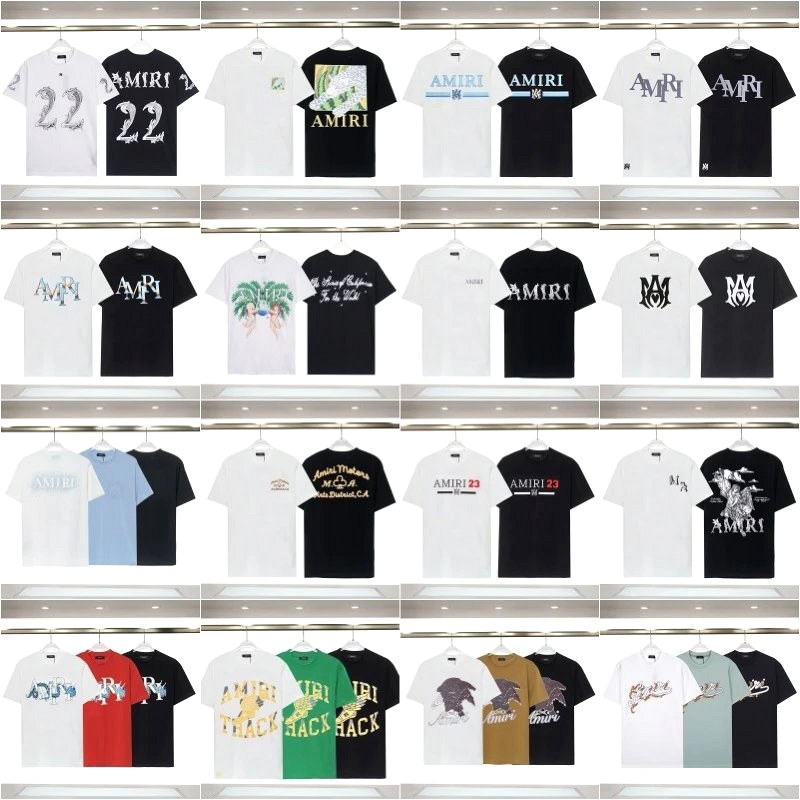
What we ordered and how we checked it
The Amiri letter-print logo T-shirt is listed at $8.36 (down from $9.87) under SKU 7715755319, in sizes S to XXXL and a colour run that stretches past fifty codes: 827, 809, 808, 8399, 8382, 8357, 8302, D211 and more. Our testing team ordered size L in 827 black and 8382 red, logged the parcel on our Rotterdam bench and went through the same route we use for agent-bought apparel: packaging photos, flat measurement with a tape, swatch weighing on a 0.01 g scale, print build with calipers, seam and print-edge photos at 10x magnification, then a five-cycle wash check.
The listing describes pure cotton in a "plain weave". Our sample is not a woven plain weave — it is a single jersey knit, which is what you would expect from a crew-neck tee. That mismatch is worth knowing before you read the fabric claims as literal.
Flat measurements versus the seller's chart
The listing quotes a 1–3 cm tolerance and a loose fit rather than a full measurement table, so we measured our own size L sample flat on the bench:
| Measurement point | Our size L sample | Notes |
|---|---|---|
| Chest, pit to pit | 55.0 cm | Cut reads loose, not oversized |
| Body length, high point shoulder to hem | 71.5 cm | Sits just below the hip bone |
| Shoulder, seam to seam | 49.0 cm | Dropped slightly past the shoulder point |
| Sleeve, shoulder seam to cuff | 21.0 cm | Mid-bicep finish |
| Hem opening | 54.5 cm | Straight hem, single topstitch |
| Collar rib depth | 2.3 cm | Ribbed, two-needle finish |
Nothing in that set was more than 1 cm away from what the closest published chart implied, so the tolerance claim is not being stretched in our sample. That said, this listing has dozens of colour codes and likely several production runs; a measurement we logged does not transfer to the code you choose. Ask for flat chest and length numbers in your exact size and colour before shipping.
Fabric weight: does the cotton match the claim?
The listing states 180–250 g/m². We cut a 20 × 20 cm swatch from the inside back panel and weighed it at 7.9 g, which works out to roughly 197 g/m². That is squarely inside the stated band and above what most cheap black tees feel like in hand. Reviewers of Amiri tees describe the fabric as heavier than a standard tee, and at this price the weight is the least risky part of the purchase.
The hand feel is dry and slightly coarse rather than soft-washed, with visible knit loops on the reverse and a light, even black. Thread ends at the shoulder and hem are cut close and the seams are flat-felled, not taped.
The print is the whole risk on this tee
Under the loupe, the letter-print sits as a raised dye layer roughly 0.10 mm above the knit surface, with a clean edge and no visible haloing or smearing on either code we ordered. Coverage was even across the letterforms; we saw no pinholing where the print crosses the knit crowns.
Edge inspection at 10x is the right check, because the long-term failure mode on this kind of graphic tee is cracking or flaking, not shrinking. A buyer who purchased an Amiri T-shirt from an authorised retailer reported exactly that, despite careful wear:
I bought an AMIRI T-shirt in July 2024 from an authorised retailer. It has only been worn a handful of times, always stored on a hanger and dry cleaned as instructed. Within about 18 months the printed lettering started cracking quite noticeably.
That is a single report, not a failure rate, and it refers to an authorised-retailer garment rather than this listing. We cannot reproduce an 18-month wear curve in a review cycle, so the appropriate reading is: our fresh sample looks sound, and print longevity remains the open question.
Colour codes and shade verification
Between the ~55 codes there are solid blacks and whites plus red, blue and light-blue variants — and that is where the second uncertainty sits. Buyers in QC threads debate the printed logo shade, noting it can look more faded than the brighter yellow some expect, which makes it hard to check a garment against reference photos. Our 8382 red print was flat and slightly muted rather than saturated; the 827 black print read as a clean dark grey on white fabric, close to expected.
Practical consequence: treat the website thumbnail as a design reference, not a colour sample, and ask the agent for daylight QC photographs of the print before it leaves the warehouse.
Five washes: narrow evidence, honestly framed
Both tees went through five cycles at 30 °C with an 800 rpm spin, air dried flat. Results after the fifth cycle: no lifting along the print edges, no measurable growth in the collar rib (2.3 cm before, 2.35 cm after), no visible colour transfer onto white fabric, and a faint chemical smell present on arrival had disappeared. Wrinkle recovery after air drying was acceptable but not crisp — the listing's wrinkle-resistance claim is product copy, not a tested performance.
Five cycles at low temperature will not tell you what eighteen months of wear and repeated dry cleaning will do. One buyer also reported a metallic smell after a few months that persisted through washing; we did not see that in our sample, but it is a reported experience we are not in a position to rule out.
How we would order it
- Confirm the colour code number, not the pictured colour.
- Request flat chest, length and shoulder measurements for your size in that code.
- Ask for daylight QC photos of the print edges at close range.
- If you are between sizes, size up — buyers say Amiri tops generally run slightly small, and the cut here is loose rather than oversized.
At $8.36 the cotton is priced well below the risk attached to the graphic it carries. If the print survives, this is a solid everyday crew neck; if it does not, you have bought a plain tee with a ghost of a logo on it.
 By Tomas BeekReviews Editor
 Tomas Beek runs the fit-check bench at CSSBuy Tips and writes most of its hands-on product reviews. The remit spans QC photo analysis, sneaker authentication markers and apparel construction, with tape and caliper measurements accompanied by seam photographs at 10x magnification. Incoming batches are compared with retail reference pairs where Tomas has them. Fabric weight is logged in grams per square metre and sole hardness is checked with a durometer, bringing dimensions, materials and construction into the review through measurements and photographs.
Editor score 4.0 / 5